A keyword research tool is a tool that helps you identify the right topics & opportunities you should write about, by analyzing keywords for search engine optimization (SEO) purposes. It’s the backbone of a proper keyword research process.
This free AI Keyword Research Tool functions by taking your main keyword or phrase, then generating a list of related keywords and their search volumes, competition levels, and (soon) a rankability score.
This data will help you identify the most effective keywords to use in your content & guide you in optimizing your blog posts for search engines. Use the list of keywords to see how much estimated organic traffic you can expect to generate from relevant Google searches on the topics you plug into the AI Keyword Research Tool.
What is an AI Keyword Research Tool?
To start with, an AI Keyword Research Tool is a useful piece of software that uses artificial intelligence, large language models, machine learning, and more, to help you find keywords for the content you plan to create.
For example, if I were using one of these tools for this article, it could recommend targeting terms such as “AI Keyword Research” or “AI SEO”.
What makes my favorite AI keyword research tools so useful is that they don’t simply provide lists of terms with the usual “volume” data and “keyword difficulty” scores. They can actually consider additional data when helping you decide what to target.
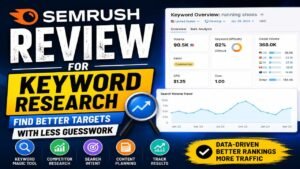
For example, Semrush allows you to enter your URL so it can provide useful insights into the types of terms your site should target.
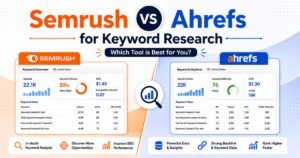
Ahrefs provides insights into customer intent when you’re researching keywords, and helps you discover long-tail terms through AI suggestions.
And we can’t forget the real-time updates. Rather than depending on outdated keyword databases, many AI keyword research tools continually scan search engines, providing the latest keyword insights as trends change.
This means no more wondering what’s relevant – AI works it out for you.
Why Use an AI Keyword Research Tool?
So, why use an AI keyword research tool?
Well, I’ve already explained why AI-powered SEO tools are much better than traditional alternatives. They provide more data, more personalized insights, and additional features. Some solutions can even help you create rankable content once you identify relevant phrases.
But maybe you’re wondering – can’t I just ask ChatGPT or Google Gemini for keyword ideas?
The simple answer is yes – you can, but you won’t get the same results. ChatGPT, for example, doesn’t have access to real-time search data – even when it can browse the web, so it doesn’t really know how many people are searching for particular terms.
You might think that Google Gemini can access ranking data (since it’s connected to Google) – but that’s not actually true. Using a specialized keyword research tool gives you access to much more than just ideas.
You get the search volume, keyword difficulty, intent analysis, and other data you need to actually select the right keywords.
Plus, many tools provide access to other SEO tools, like solutions for backlink analysis, site audits, rank tracking, and so on. It’s simply a better overall experience for SEO professionals.
Semrush: Overall AI Keyword Research Tool
I had a soft spot for Semrush long before it introduced AI capabilities; I’ve been using this platform for years. But the version I’m recommending now is Semrush One, the unified plan that combines the classic SEO toolkit with the new AI Visibility toolkit in one subscription. That second half is why this section looks different from how it would have appeared a year ago.
Semrush One brings AI into both sides of the research process. On the traditional side, every AI Keyword Research Tool (Keyword Overview, the Keyword Magic Tool, and so on) includes an AI-powered feature.
In the Keyword Magic Tool, for instance, you can let AI analyze your domain and provide personalized data, so you can target terms you’re actually more likely to rank for. This has guided me toward phrases I might otherwise have ignored because of high difficulty scores, by showing me that my domain had more potential than the raw number indicated.
What’s genuinely new is the AI Visibility side. Search isn’t just Google anymore: a growing share of buyers ask ChatGPT, Gemini, Perplexity, and Google’s AI Overviews instead of typing into a search bar. Semrush One tracks how your brand appears across those surfaces, and two features handle most of the work:
- AI Visibility Score: a 0 to 100 benchmark showing how visible your brand is in AI-generated answers for your topics, so you can quickly see whether AI engines are surfacing you or your competitors.
- Prompt Research: essentially an AI Keyword Research Tool for the AI era. Enter a topic and you get AI topic volume, difficulty, and intent for the prompts people are actually asking, so you can create content around the questions LLMs are answering.
Together, these change the question from “am I ranking?” to “am I being mentioned and cited?”, which is the one that matters as AI search continues taking share.
Why Semrush is the Best
With Semrush One, you get:
- Personalized metrics: up-to-date insight into how your domain may rank for specific keywords and phrases, plus what you’re already ranking for through your AI Keyword Research Tool.
- AI visibility tracking: the AI Visibility Score and Brand Performance reports that show where and how AI platforms mention you compared with competitors.
- Keyword and prompt strategy: use AI to generate a complete list of semantic terms and topics for a piece of content, or use Prompt Research to map the AI prompts worth targeting with an AI Keyword Research Tool.
One thing worth clearing up, because it trips people up: the standalone Content Toolkit (ContentShake AI) is a separate $60/month add-on.
But Semrush One Pro+ and Advanced bundle the content optimization tools, SEO Writing Assistant, SEO Content Template, and Topic Research, so on those tiers you can research, brief, and optimize content without paying for the Content Toolkit separately.
On the entry-level Starter tier those content tools are limited, so it’s worth knowing which plan you’re using before you budget for content and your AI Keyword Research Tool needs.
Who Should Use Semrush
If you’re serious about visibility in both traditional search and AI answers, Semrush One is the plan I’d point you to. I’ve used it to push content to the top of the results and, increasingly, to get pieces surfaced inside AI answers while saving real time across my workflows with an AI Keyword Research Tool.
If your work is purely traditional SEO with no interest in AI visibility yet, the classic SEO toolkit without the AI Visibility layer may be enough, and cheaper.
Where Semrush Falls Short
The obvious downside is cost. Semrush One isn’t cheap, and the tiers climb quickly:
- Starter: $199/month
- Pro+: $299/month
- Advanced: $549/month
So if you want the higher limits and the bundled content tools, you’re looking at $299 to $549 a month, which puts it out of reach for the ultra-budget-conscious. The upside: you can test it before committing to this AI Keyword Research Tool.
Use our link to unlock a 14-day free trial, longer than the standard 7-day one, so you can put the AI Visibility features through their paces first with your AI Keyword Research Tool.
Moz: Best for Domain and Competitor Insights
Honestly, there are plenty of things to love about Moz.
First, I’m a big fan of how user-friendly the entire searching experience is – even if you’re not an SEO expert. The keyword explorer, with its new AI-powered features, is particularly intuitive, making it easy to drill down into keyword lists and align your choices with intent metrics.
Those intent metrics are very in-depth too – thanks to Moz’s two-layer process that uses an ML classification model and a rules-based model at the same time.
Moz is also excellent for getting more detailed insights into keyword opportunities for your specific domain – like Semrush.
Once you enter your domain into the system, it can help you identify domain search themes and keyword topics instantly.
That saves me a lot of time when I’m planning pillar content strategies and “content buckets” – you’ll know what I’m talking about if you’re in the content industry.
Best for: SEO experts in small to mid-sized businesses who want an easy way to get insights into domain-specific keywords and content strategies.
Downside: Moz’s keyword database is a little smaller than some competitors, and it doesn’t have the same “advanced” features as some alternatives.
Pricing: Starting at $49 per month
Free trial: 30 days
Moz has been adding artificial intelligence to its SEO solutions for quite some time now.
As of 2024, the platform is more powerful than ever before. Last year, the company introduced a complete suite of “Moz AI” tools for Pro plan users, offering access to:
New intent insights in the Keyword Explorer
Domain snapshots powered by AI
Enhanced AI ethics and risk management tools
Surfer SEO: Best for Keyword Research in the Flow of Work
What I love most about Surfer SEO is that it keeps me focused and on-task.
I’m not constantly referring to a specific list of keywords and marking off how many times I’ve used them. The tool does that for me, so I can focus on making the content as appealing and engaging as possible.
Once I’ve found a relevant keyword I want to rank for, I can input the term into Surfer SEO, and it will automatically generate a list of related and semantic terms to include in the article.
Then I can start writing immediately, in the same interface – tracking my progress as I go.
You can even access advanced tools throughout the process, creating a topical map of your domain or a specific topic, so you know how to progress from one content piece to the next.
Best for: Content creators who want to save time and energy when optimizing their pieces for the search engines.
Downside: Not as advanced for central keyword research as some other tools, like Semrush.
Pricing: Starting at $79 per month
Free trial: 7-day money back guarantee
I’m a huge fan of Surfer SEO for a few reasons. It’s convenient, easy to use, and gives you direct access to SEO data while you’re actually writing.
That means you’re not constantly moving back and forth between apps to figure out if you’ve used certain terms the right number of times.
With Surfer SEO’s keyword tools, you can:
Instantly identify relevant keywords based on news and specific topics
Monitor your content’s SEO in real-time, with instant scores and updates
Automatically add keywords and backlinks into your content as you write
Ahrefs: Best for Insights Across Search Engines
The best thing about Ahrefs is that it doesn’t focus exclusively on Google when it’s helping you identify important keywords.
When you open the “AI suggestions” feature in the keyword explorer, you can ask it to focus on high-value terms across different channels, like YouTube, Amazon, or Bing. That’s great if you want to expand beyond Google.
You also get plenty of different keyword ideas (including long-tail phrases), and you can constantly update your instructions to find keywords in other languages, or fine-tune responses.
I also love how much data Ahrefs provides – particularly about search intent. You can quickly identify the “intent” of customers searching for specific keywords, which makes it easier to create more compelling content campaigns with an AI Keyword Research Tool.
Best for: Content creators who want to expand their content’s reach beyond Google, and access valuable intent data.
Downside: The pricing can be a major barrier for individuals and startups with limited budgets.
Pricing: Starting at $99 per month (paid annually)
Free trial: For some tools
Ahrefs is another tool I have plenty of experience with as a content creator. It’s always been useful for gaining insights into competitors and marketing data. The AI tools are pretty impressive here – particularly for AI Keyword Research Tool users. You can:
Get instantly generated keyword suggestions for a range of search engines
Access AI search intent insights
Get help creating AI content
Leverage AI for technical SEO audits
AI Keyword Research Tools : Final Thoughts
Ultimately, AI keyword research tools are a real advantage in the SEO landscape – saving content creators serious effort when it comes to creating pieces that can actually rank.
Whether you’re just getting started in the SEO space, or you want to improve your game, I definitely recommend giving at least one of these AI Keyword Research Tool options a try:
- Semrush for the best all-around AI experience
- Ahrefs for robust multi-search-engine analysis
- Moz Pro for excellent domain insights
- Surfer SEO for streamlined SEO support in the flow of work
Not sure which option to go for? Most offer a free trial or demo, so I’d recommend testing those out first. Yes – upgrading with a few of these tools can be expensive.
Trust me though – it’s worth it for all the time and energy you’ll save with an AI Keyword Research Tool.