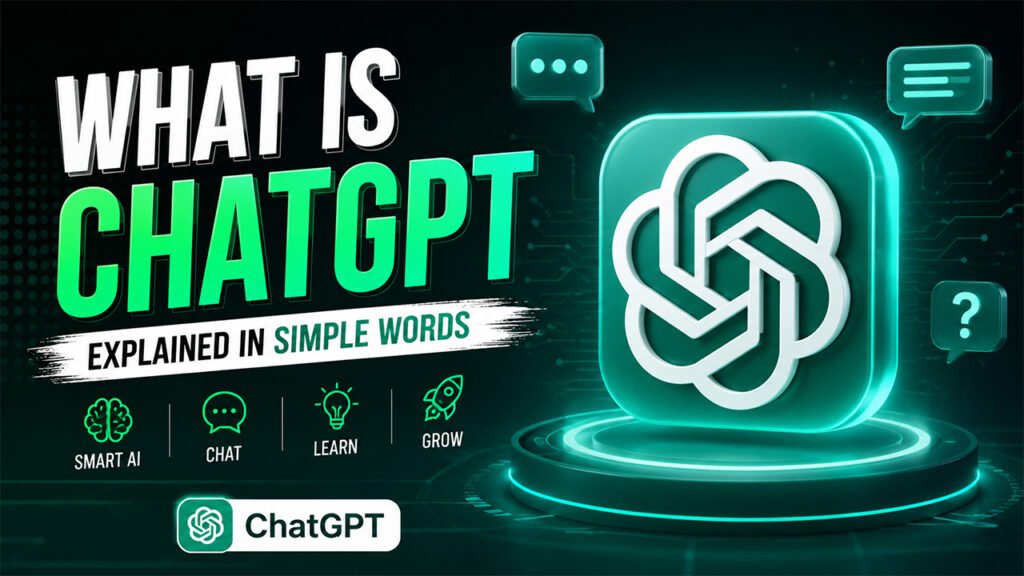
Nowadays, there are very few people who use the internet but have not heard of ChatGPT. Currently, the discussion about artificial intelligence or AI is increasing day by day, and one of the most heard names is ChatGPT. Many are using it, while many have only heard the name but do not have a clear idea about its work. what is ChatGPT, In fact, ChatGPT is an AI-based assistant that can understand human language and answer various types of questions, create texts, and assist in various types of work.
Many people want to know what is ChatGPT actually is, how it works, and can it really be an alternative to human work?
In this article, we will learn in detail about ChatGPT in simple language. The topics will be explained with real examples, avoiding technical complexity, so that even new users can understand it easily.
What is ChatGPT?
What Is ChatGPT? Simply put, ChatGPT is a language-based AI model that can understand human-like language and respond accordingly. When you ask a question or give instructions, it analyzes that information and tries to generate an appropriate response.
It is based on a Large Language Model. It has learned language patterns, sentence structure, and word usage rules from a large amount of writing examples. So when you ask a question, it can formulate an answer to a new question in its own language. However, it does not think like a human or answer from its own experience. Rather, it generates the most appropriate answer possible based on the information it has learned.
For example—
You type: “Write a job application.” ChatGPT can create a complete application in a few seconds.
Again, if you say— “Make my English writing easier.” It can also convert the writing into simpler language.
This is why many people—students, teachers, freelancers, businessmen, content writers, and software developers—are currently using ChatGPT.
A brief history of ChatGPT
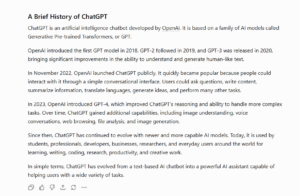
Research on artificial intelligence has been going on for many years. ChatGPT was created as a continuation of that research.
Its main objective was to create an AI with which humans can converse in natural language.
Initially, it had relatively limited capabilities. But with the addition of new versions over time, it has now become much more advanced. Today, it can help not only with writing, but also with logic analysis, image understanding (in certain versions), programming, planning, and many other tasks.
How does ChatGPT work?

Many people think that ChatGPT might search the internet and answer the question. Actually, that’s not always the case.
It is basically an AI model trained on language patterns, sentence relationships, and various information. When you ask a question, it tries to understand the meaning of the question and creates a new answer accordingly.
That is, it does not simply copy text from a website. Rather, it uses the learned language patterns to create its own answer.
That is why the answer may be slightly different if two people ask the same question.
Simply put, the whole process is like this—
The user writes the question.
The AI analyzes the meaning of the question.
Generates the best possible answer.
Displays it in front of the user within a few seconds.
The whole process is completed very quickly.
Why is ChatGPT so popular?
There are a few important reasons behind its popularity. First, it can speak in natural language. Even without using technical jargon, ordinary people can easily write their own questions and get answers in simple language. Second, it is not just for a specific task. It can be used for writing, studying, planning, translating, summarizing information, programming and many other types of tasks. Another big advantage is that if you ask a question repeatedly on the same topic, it tries to answer it by keeping the context of the previous conversation. As a result, the conversation feels more natural.
What Can You Do with ChatGPT?

The biggest advantage of ChatGPT is that it can be used for multiple purposes. Whether you are writing, studying, handling office work or just want to learn something new—it can be helpful in almost all cases.
1. Writing and editing
If you want to write an article, blog, email, application, report or social media post, you can create a draft from ChatGPT. It can also help to make an already written text clearer, concise or interesting.
2. Finding new ideas
Sometimes a good idea is needed to start a project. ChatGPT can also offer various suggestions on such matters as a new business name, content topic, video title, marketing plan or story plot.
3. Study and learning assistant
It can also be useful for tasks such as understanding a difficult topic in simple terms, making notes for exam preparation, knowing the essence of important topics or creating questions for practice.
4. Programming Help
Those who work with software or web development can use ChatGPT to find code examples, identify errors, understand different programming concepts, or find ways to solve a specific problem.
5. Daily Planning
It is also useful for creating personal to-do lists, organizing travel plans, creating study routines, planning meals, or determining what to do to achieve specific goals.
6. Office Work
Many offices have to do many similar tasks every day. For example, writing emails, drafting reports, organizing meeting notes, summarizing information, making plans, ChatGPT can be useful for starting these tasks quickly.
7. Language Learning and Translation
ChatGPT can also be used to translate text from one language to another, learn words and sentences in a new language, or practice conversation.
8. Business Work
Small or medium business owners can also use ChatGPT in various ways. For example, writing advertising copy, ideas for social media posts, drafting answers to common customer questions, writing product descriptions, drafting business plans, but human scrutiny is always needed when making important business decisions.
Real-world example
Let’s say Rahim runs a small online store. It used to take him a lot of time to write a separate description for each new product every day.
Now he uses ChatGPT to create a first draft. Then he edits the text according to his business information. This takes less time, but he checks the final text himself.
On the other hand, Sumi is a university student. While studying a large chapter before an exam, he uses ChatGPT to help him summarize important points. Then he studies along with the book.
These two examples show that ChatGPT works best when it is used as an assistant to humans, not as a substitute for humans.
How to ask questions to get good ChatGPT results?

A simple rule for getting good answers from ChatGPT is to be clear about the instructions.
For example, if you just type, “Tell me about marketing.” The answer will be general. But if you type, “Create a 7-day low-cost marketing plan for a new online clothing store,” the answer will be much more specific and effective.
If necessary, you can also specify the writing style, word count, language quality, or format. For example, “Write in 300 words in plain English” or “Use bullet points.”
If you don’t like the first answer, there’s no need to start over. Instead, just type in any part you want to change or go into more detail, and ChatGPT can edit the answer accordingly.
Use of ChatGPT in various fields

The use of ChatGPT can vary depending on a person’s needs. It can be used effectively from academic life to professional work or creative content creation.
For students
If you have trouble understanding a topic while studying, ChatGPT can explain it in simple language. It can also help you create a summary of a large chapter, organize important points for exams, create practice questions or draft an assignment. However, you should check and edit it yourself before submitting it.
For employees and professionals
ChatGPT can be very helpful in writing office emails, creating meeting notes, organizing project plans, drafting reports or organizing the main points for a presentation. This saves time and increases the speed of work.
For content creators and marketers
Those who create content regularly can use ChatGPT to select new topics, create video scripts, blog outlines, social media posts or campaign plans. It also helps in finding new perspectives.
For developers
ChatGPT can also be useful for finding possible causes of code problems during programming, creating example code, getting ideas about new technologies, or writing documentation.
What tasks is ChatGPT best for?
ChatGPT is not equally efficient for all types of tasks. It gives very good results in some specific cases.
Quick idea generation: If you don’t have any ideas in mind, ChatGPT can quickly give you many options.
For example— blog topics, YouTube video ideas, business names, marketing concepts, social media post ideas. This is mainly very useful for “brainstorming”.
Draft creation: ChatGPT can create an initial draft very quickly.
For example— email, code creation, blog articles, reports, presentation notes, but the final version always needs to be verified by the user himself.
Simple explanation: ChatGPT is good for explaining any complex topic in a simple way. For example— what is a black hole, how does SEO work, how does the internet work?. It can explain these in simple language.
Things to keep in mind when using ChatGPT
Although ChatGPT is a powerful assistant, there are some things to keep in mind when using it.
Never share personal or confidential information, such as passwords, bank account information, or sensitive documents.
If you are using any writing for publication, research, or important work, it is best to verify the accuracy of the information from a reliable source.
Additionally, you should use your own judgment and not rely solely on AI when making important decisions.
Some limitations of ChatGPT and things you need to know about ChatGPT
In what areas is ChatGPT weak?
Like all AI tools, ChatGPT also has some limitations.
Although ChatGPT is skilled in many areas, it cannot answer all questions perfectly. Many people think that ChatGPT always gives 100% accurate information. In reality, this is not the case. Although it gives helpful answers most of the time, there is a possibility of making mistakes. Therefore, it is necessary to check with reliable sources before using important information
It does not always give 100% accurate information. Sometimes it can provide outdated or incomplete information. Therefore, it is necessary to verify it in important decisions.
No real experience. ChatGPT is not a human, so it does not know anything from real experience. It only answers based on learned data. Very specific or new information. Very new events or updated information may not always be accurate.
To know about any recent event or new information, using reliable and updated sources is the safest way.
ChatGPT Free vs Plus: Key Differences

There are two main versions of ChatGPT—Free and Plus.
Free Version
Free to use
Good for general questions and tasks
Can be slow at times
Has some limited features
Plus Version
Requires monthly subscription
Gets faster answers
Advanced models available
Good performance even during busy times
Simply the difference
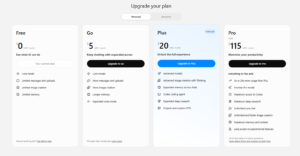
Free = Basic usage
Plus = More powerful and faster experience
Benefits of using ChatGPT
There are many benefits to using ChatGPT, especially for those who want to work quickly.
- Saves time: ChatGPT can create the first draft of a task that takes a lot of time for humans to do, in a few seconds.
- Easier to get ideas: Many times nothing comes to mind. Then ChatGPT helps to give new ideas.
- Easier to learn: It can explain difficult topics in simple language, so it is helpful in studying.
- Usable for multiple purposes: Writing, coding, translating, planning—it can help in something or the other.
- Can be used 24/7: Can be used whenever you want, there is no time constraint.
Disadvantages of Using ChatGPT
Along with the advantages, there are some limitations.
- Not all information is always accurate: Sometimes it may provide incorrect or incomplete information.
- Not a substitute for human thinking: It can help, but it is not a substitute for human thinking, experience, and decision-making.
- Over-reliance can create problems: Leaving all the work to ChatGPT can reduce your ability to think.
- Creativity can be limited: Even if you provide ideas, they may not always be original or deep.
Who Can Benefit Most from Using ChatGPT?
Students: Those who are studying in school, college or university—they can get a lot of benefits by using ChatGPT to understand complex topics, make notes, summarize or prepare for exams.
Employees and professionals: It is very useful for writing emails, creating reports, brainstorming ideas, presentations or saving time.
Freelancers and content creators: Helps to work quickly on writing, scripts, blogs, social media posts or idea generation.
Entrepreneurs and businessmen: Can use it to get business plans, marketing ideas, customer communication or ideas for new projects.
Those who are learning something new: It can act as an “on-demand tutor” while learning English, programming, design or any skill.
General users: Can get quick solutions to cooking, travel plans, general information about health, or daily problems.
In short, ChatGPT is most useful for those who know how to ask questions and are interested in learning.
Conclusion
What Is ChatGPT? ChatGPT is a technology that, if used correctly, can make daily tasks easier, faster, and more organized. It can play a valuable role as an assistant in almost all areas, be it writing, learning, planning, research, or creative work.
However, instead of assuming its answer as the ultimate truth, the best method is to verify it as needed and use it in conjunction with your own experience and judgment. No matter how advanced AI is, it is not a substitute for human thinking, decision-making, and real experience. Rather, it is possible to get the most out of this technology by using it as an assistant.
What Is ChatGPT? ChatGPT is a powerful AI tool that helps make our daily tasks easier and faster. However, it is not a substitute for humans—it is rather a supporting medium.
If used correctly, it can be very useful in all areas, including study, work, and creative work.