Choosing between Semrush vs Ahrefs affects more than your monthly bill. The wrong platform can leave gaps in competitor research, limit backlink data, or force your team into slow manual work. Semrush vs Ahrefs comes down to goals, budget, team size, preferred data, and the reports you use every week.
Both platforms cover keyword research, backlink analysis, site audits, rank tracking, content research, and competitor monitoring. Their strengths differ, though, so the better choice depends on the work your team does most.
Semrush vs Ahrefs at a Glance
Semrush is a broader marketing platform. It combines SEO with PPC research, advertising data, local SEO, content tools, social media features, reporting, and competitive intelligence. It fits agencies and teams that manage several marketing channels.
Ahrefs focuses more closely on SEO research. Its strongest areas include backlink discovery, content opportunities, keyword analysis, competitor pages, and focused technical audits. It often suits link-building teams, publishers, and content-led SEO programs.
| Platform | Strongest use cases | Main limitation | Learning curve |
| Semrush | SEO, PPC, local, content, reporting, competitor ads | More features and add-ons can raise costs | Moderate to high |
| Ahrefs | Backlinks, content gaps, keyword and page research | Fewer built-in paid-search workflows | Moderate |
Semrush may suit a business comparing organic and paid search competitors. Ahrefs may suit an editorial team that spends most of its time finding topics, ranking pages, and link prospects. Check country coverage, search-engine support, and usage limits before choosing either tool.
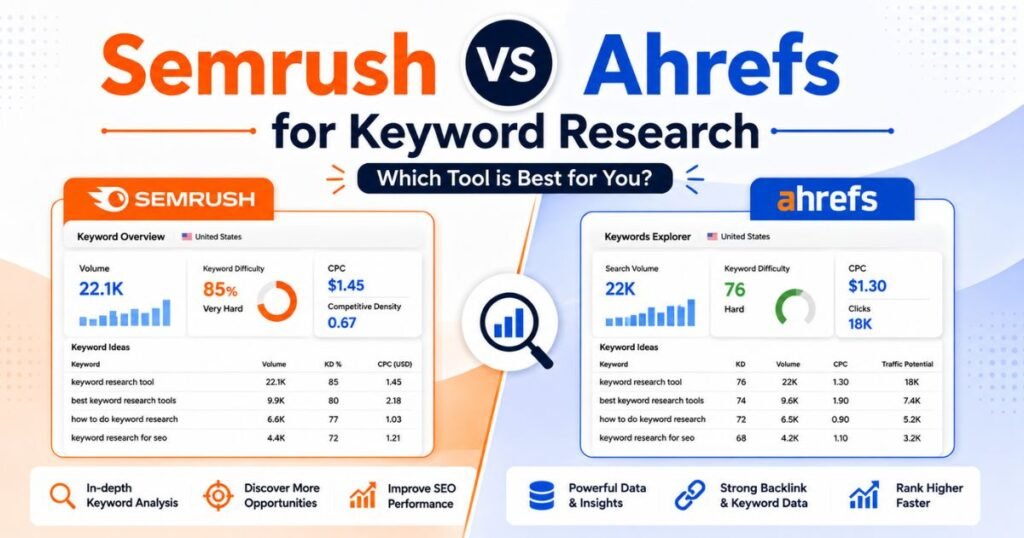
Keyword Research Shows Different Strengths in Semrush vs Ahrefs
Semrush supports broad keyword research through Keyword Overview, Keyword Magic Tool, Keyword Gap, intent labels, difficulty scores, related terms, and question-based searches. Its competitor reports also show where rival domains rank and which terms may have paid-search value.
Ahrefs uses Keywords Explorer, matching terms, related terms, search suggestions, parent topics, traffic potential, SERP analysis, and Content Gap. Its SERP overview helps you review ranking pages, referring domains, estimated traffic, and the type of content Google currently favors.
Semrush vs Ahrefs: Which Tool Is Better?
| Research task | Semrush | Ahrefs |
| Keyword discovery | Keyword Magic Tool and related terms | Keywords Explorer and matching terms |
| Intent analysis | Intent labels and keyword groups | Search intent and SERP review |
| Competitor gaps | Keyword Gap | Content Gap |
| SERP inspection | SERP features and competitor results | SERP overview and history |
| Paid-search data | Strong organic and PPC connection | More limited |
| Content planning | Topic Research and content tools | Parent topics, traffic potential, Content Explorer |
Use either platform to filter terms by intent, business value, difficulty, and realistic traffic potential. High search volume alone doesn’t make a keyword useful. Review the actual results before choosing a format: a product page, comparison, guide, or category page may each target a different need.
Search volume and difficulty are estimates, not promises. Data can differ because of collection methods, country settings, SERP changes, local results, and update schedules. Confirm important opportunities with Google Search Console and Google Ads Keyword Planner when possible.
Backlink Analysis Shows Where Each Platform Fits Best
Ahrefs is often the stronger choice for detailed link research. Site Explorer includes referring domains, new and lost backlinks, broken backlinks, anchors, linked pages, Best by Links reports, and Link Intersect analysis.
These reports help you find competitor link sources, reclaim lost links, discover broken-link prospects, and identify pages that attract attention. Compare three or more competitors to find domains linking to several businesses in your niche but not to your site.
Semrush connects backlink analysis with wider domain and campaign data. Backlink Analytics, Backlink Gap, link-risk signals, new and lost link reports, and link-building prospect workflows can help agencies keep research and client reporting in one system.
| Link task | Better fit |
| Detailed competitor link discovery | Ahrefs |
| Link gap comparisons | Both |
| Outreach prospecting | Ahrefs for link depth; Semrush for workflow |
| Risk indicators | Semrush |
| Lost-link monitoring | Both |
| Wider marketing reports | Semrush |
Raw backlink totals can mislead. Review referring-domain quality, topical relevance, editorial placement, the linked page, and organic traffic. Don’t disavow links only because a third-party toxicity score is high; inspect the link manually and follow Google’s current guidance.
Site Audits Depend on Your Technical SEO Priorities
Semrush vs Ahrefs and Semrush Site Audit checks crawlability, indexability, internal links, HTTPS, metadata, duplicate content, structured data, and page experience signals where supported. Its Site Health score also connects technical findings with rankings, content work, and reporting.
Ahrefs Site Audit covers crawl health, canonicals, redirects, broken links, metadata, content quality, internal-link opportunities, JavaScript rendering where supported, and historical audit comparisons. It fits teams that want technical review close to content and backlink research.
Prioritize indexation, canonical tags, important templates, internal links, and user experience before minor warnings. Segment issues by page type, directory, traffic, or revenue so a low-value URL doesn’t receive the same attention as a key landing page.
Validate automated findings in Google Search Console, server logs, browser tools, XML sitemaps, analytics, and manual SERP checks. An audit score helps set priorities; it isn’t a ranking factor.
Competitor and Content Research Give Semrush a Wider Marketing Edge
Semrush combines Organic Research, Keyword Gap, Traffic Analytics where available, Advertising Research, PLA and paid-keyword data where available, Topic Research, and content optimization tools. This helps teams compare organic landing pages, paid keywords, ad activity, and content themes in one workflow.
Ahrefs makes competitor page research clear through Site Explorer, Top Pages, Content Gap, Competing Pages, Content Explorer, and referring-page reports. You can find pages earning links and search traffic, then decide if a more useful, current, or complete resource is justified.
A repeatable workflow works in either platform: select three to five real competitors, export overlapping and missing terms, group them by intent, review strong pages and links, check your own rankings and conversions, then prioritize topics by value, difficulty, and effort. Competitor metrics reveal possible opportunities, not guaranteed results.
Pricing, Limits, and Reporting Decide the Real Value
The current Semrush pricing page lists the SEO plan at $139 monthly, or $117.33 per month when billed annually. Starter is $199 monthly, Pro+ is $299, and Advanced is $549; annual prices shown are $165.17, $248.17, and $455.67 per month.
The Ahrefs pricing page lists Lite at $129 per month, Standard at $249, Advanced at $449, and Enterprise at $1,499 with an annual commitment. Ahrefs also lists tracked keywords, crawl credits, rows, projects, users, and historical data more clearly on its public comparison.
| Plan level | Semrush public limits | Ahrefs public limits |
| Entry | 5 websites; 500 daily tracked keywords | Lite: 5 projects; 750 keywords; 100,000 crawl credits |
| Mid | Pro+; 15 websites; 1,500 keywords; historical data | Standard: 20 projects; 2,000 keywords; 500,000 crawl credits |
| Advanced | 40 websites; 5,000 keywords; API data integration | Advanced: 50 projects; 5,000 keywords; 1.5 million crawl credits |
| Users | Extra users start at $45 monthly | One included; paid additions vary by plan |
| Reports and exports | Reporting add-ons start at $10 monthly | Export and report limits vary by plan |
| Trial or refund | Semrush advertises seven-day access | Ahrefs Free is available; paid refunds are limited |
Semrush’s public summary doesn’t show every crawl, export, backlink-row, or report limit. Confirm those figures during purchase. Promotional pricing, annual billing, taxes, add-ons, seats, and API access can change the final cost.
Calculate your likely monthly use: websites, tracked keywords, crawl volume, users, exports, reports, and research sessions. A wider toolset may replace separate PPC, local, social, or reporting software, while Ahrefs may provide better value for a focused SEO team.
The Best Choice Depends on the SEO Team
Semrush fits agencies and multi-channel departments that need SEO and PPC research, client reports, local workflows, advertising intelligence, and broad integrations. Test project capacity, report branding, user access, exports, and add-on costs before signing up.
Ahrefs fits link-focused teams, publishers, outreach specialists, and content programs that need backlink investigation, Content Gap research, competitor page analysis, and a focused interface. Check keyword coverage and traffic estimates for each target country.
Some organizations should use both. One platform can support paid-search and keyword research while the other handles link analysis. Dual subscriptions make sense only when each tool answers a clear question and produces enough extra value to cover its cost.
Conclusion
Semrush is generally more compelling for broad marketing intelligence and connected SEO/PPC work. Ahrefs is generally stronger for backlink research, content discovery, and focused SEO analysis. Both can support audits, rank tracking, keyword research, competitor analysis, and reporting, but their data views and limits differ.
Before deciding, define the main SEO goal, list the reports your team needs, check country-specific coverage, test both tools with the same site and competitors, and confirm current plan limits. Choose the platform that removes the most friction from your recurring work.
The better tool isn’t the one with the longest feature list. It’s the one that gives your team reliable insight and helps people act on it consistently.