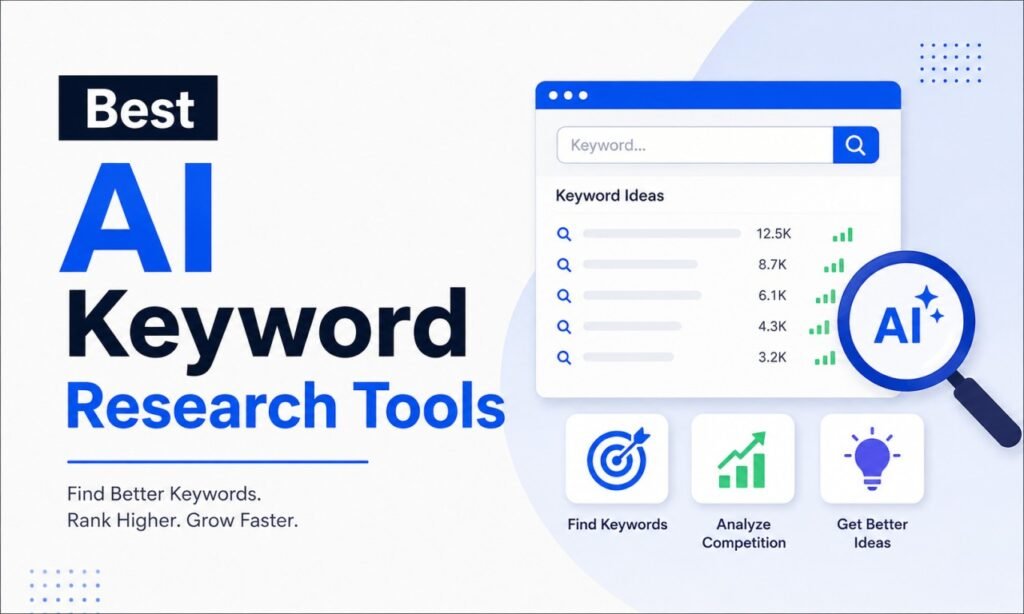
AI Keyword Research Tools is the process of finding the exact words and phrases people type into Google,
and search platforms when they search for something related to your website or business.
Tells you what your audience is searching for, how many people search for it each month, and how hard it is to rank for those terms.
Without you’re guessing what to write about and hoping it matches what people actually search for.
Tells you exactly which topics to target, which pages to create,
and which keywords give you the best chance of appearing in search results and driving traffic to your site.
There’s no shortage of tools purpose-built for AI Keyword Research (literally hundreds of them),
and they run the gamut from beginner-focused to highly advanced.
They also range from totally basic and unhelpful to super valuable.
When done right, the best AI Keyword Research tools simplify and streamline your workflow—
they make it easier to find the right keywords to target and give you the data you need to actually rank for them.
But they shouldn’t require you to empty out your bank account and sell your first-born child in order to access that data.
After years of working with multiple clients who use all different tools for AI Keyword Research and SEO content optimization,
I’ve seen the best (and the worst) of them—
and I know how important it is to choose the right AI Keyword Research tool.
After in-depth testing, here are the five best free AI Keyword Research tools,
including the all-around greats and apps built for more specific use cases.
What Is an AI Keyword Research Tool?
First things first,
an AI Keyword Research Tool is a handy bit of software that uses artificial intelligence, large language models, machine learning,
and so on, to help you identify keywords for the content you want to produce.
For instance, if I was using one of these AI Keyword Research Tools for this article,
it might suggest targeting terms like “AI Keyword Research” or “AI SEO”.
What makes my favorite AI Keyword Research Tools so awesome is that they don’t just give you lists of terms with
the average “volume” insights, and “keyword difficulty” scores.
They can actually take extra data into account when showing you what to target.
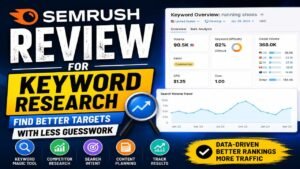
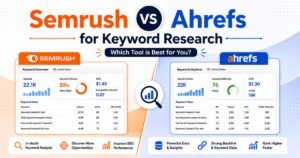
Case in point, Semrush lets you input your URL so it can give you genuine insights into what kind of terms your site should target.
Ahrefs gives you insights into customer intent when you’re exploring keywords,
and helps you brainstorm long-tail terms with AI Keyword Research suggestions.
And let’s not forget the real-time updates.
Instead of relying on outdated keyword databases, many AI Keyword Research Tools scan search engines constantly,
giving you the freshest keyword insights as trends shift.
This means no more guessing what’s relevant – AI figures it out for you.
Our Top 5 AI Keyword Research Tools
Google Keyword Planner – Completely free AI Keyword Research
Semrush – Best all-in-one AI SEO toolkit
Ahrefs – Best for multi-platform AI Keyword Research insights
Moz Pro – Best for domain and competitor analysis
Surfer SEO – Best for in-editor AI Keyword Research optimisation
The Best Free Ai Keyword Research Tools at a Glance
Quick side-by-side breakdown to help you find the best fit:
| Tool | Overall Rating | Price (monthly) | Free Trial | Best For | Key Feature |
| Semrush | ⭐ 4.8/5 | From $165 | 14-day free trial | All-in-one AI-powered SEO campaigns | Keyword + content + backlink tools |
| Ahrefs | ⭐ 4.6/5 | From $99 | Limited tools free | Cross-channel keyword research (Google, YouTube) | Multi-engine AI keyword suggestions |
| Moz Pro | ⭐ 4.3/5 | From $49 | 30-day free trial | Competitor and domain analysis | AI-powered search intent analysis |
| Surfer SEO | ⭐ 4.2/5 | From $99 | 7-day refund window | On-the-go content writers | Real-time SEO scoring |
| Google Keyword Planner | ⭐ 4.1/5 | From $19 | free | Researching paid keywords | Completely free (but you get more out of it if you use Google Ads) |
The best free Ai keyword research tool for paid keywords
1. Google Keyword Planner
Google AI Keyword Research Planner pros:
- Completely free forever, even if you don’t use Google Ads
- Helpful AI Keyword Research forecasting features for budgeting if you do use Google Ads
- Can pull AI Keyword Research suggestions from just your website
Google AI Keyword Research Planner cons:
Not as helpful for organic AI Keyword Research
When it comes to PPC AI Keyword Research, Google Keyword Planner is one of the best tools out there.
It’s completely free (even if you don’t buy Google Ads), so you never have to worry about running into limits or expensive upgrades.
Google Keyword Planner includes two main features:
one for exploratory AI Keyword Research and discovery and another for more in-depth AI Keyword Research on search volume and forecasting.
The AI Keyword Research ideas feature is similar to many of the tools on this list:
you search for a seed term, and it generates other AI Keyword Research ideas, along with
details on monthly search volume, change over time, competition, ad impression share, and bid ranges.
You can refine your AI Keyword Research list by brand or non-brand keywords, source website, and more.
If you’re also using Google Ads, the Forecast feature makes it easier to plan ahead for your paid ads and AI Keyword Research budget in advance.
Keyword Planner can inform your organic strategy, too,
by showing you where ranking organically may help you save on PPC costs and improve your AI Keyword Research strategy.
Google AI Keyword Research Planner pricing: Free
2. Semrush
Semrush is a comprehensive AI Keyword Research marketing suite that has integrated AI into many areas of its platform.
Their Semrush One platform brings together traditional SEO tools
with AI Keyword Research tracking and geo-targeting features, making it a capable tool for anyone managing both organic search and Google Ads campaigns.
A notable feature of Semrush is its personalized AI Keyword Research metrics.
Its AI can analyze your website to calculate a Personal Keyword Difficulty (PKD%),
which tells you which AI Keyword Research keywords you have a better-than-average chance of ranking for based on your site’s authority.
Their AI Visibility Toolkit is also useful for keeping tabs on how your brand is being mentioned in AI search results and AI Keyword Research.
Pros: The main advantage of Semrush is the breadth of its features.
It offers a wide range of marketing tools in a single subscription, including AI Keyword Research tools.
Cons: The price can be a significant investment, particularly for freelancers or smaller businesses,
and some AI Keyword Research features may be locked behind higher-tier plans or sold as separate add-ons.
Pricing: The “Starter” plan for Semrush One starts at $165.17 per month if you pay annually.
3. Ahrefs
Ahrefs is a popular AI Keyword Research tool among SEO professionals, known for its massive backlink index and robust AI Keyword Research data.
They have added AI-powered tools like Brand Radar, which is designed to track your brand’s mentions across various AI chatbots.
Ahrefs is known for its deep competitive intelligence.
The AI Keyword Research Explorer uses AI to generate smart AI Keyword Research suggestions and analyze search intent with impressive accuracy.
It’s all powered by a database of over 28.7 billion AI Keyword Research keywords.
Pros: Ahrefs delivers deep AI Keyword Research data, and their free Ahrefs Webmaster Tools is a valuable resource for website owners.
Cons: Their credit-based system on paid plans can be a limitation.
The 500 monthly credits you get on the Lite plan can be used up quickly,
requiring the purchase of more credits to continue working with AI Keyword Research.
Pricing: The “Lite” plan starts at $129 per month.
4. Moz Pro
Moz Pro is one of the original players in the AI Keyword Research space, and they have enhanced their platform with AI.
It’s especially good at giving you high-level insights into your site’s topical authority and is the creator of the industry-standard Domain Authority (DA) metric.
Moz’s AI Keyword Research can analyze your website to identify Domain Search Themes, which is useful for planning out content hubs and building authority.
It’s also very user-friendly, making it a great starting point for anyone new to AI Keyword Research.
Plus, their educational resources, like The Beginner’s Guide to SEO, are top-notch.
Pros: Moz makes complex SEO concepts easy to understand, and its AI-powered AI Keyword Research search intent analysis is solid.
Cons: Its AI Keyword Research and backlink databases are smaller than what you’ll find with Semrush and Ahrefs, so you might miss out on some niche opportunities.
Pricing: The “Starter” plan is very accessible, beginning at $49 per month.
5. Surfer SEO
Surfer SEO is built to bridge the gap between AI Keyword Research and content writing.
It gives you real-time AI Keyword Research optimization feedback directly in its Content Editor.
The tool analyzes the top-ranking pages using natural language processing (NLP) and over 500 different web signals to create a data-driven roadmap for your article.
The workflow is a key feature. Instead of switching between an AI Keyword Research list and a document, Surfer tells you which terms to include, how many times, and where, all while you’re writing.
Its AI Tracker also monitors your brand’s visibility in AI chats like ChatGPT and Perplexity, which shows they’re thinking about the future of AI Keyword Research.
Pros: Its biggest advantage is convenience. It gamifies the optimization process with a “Content Score”
that keeps you motivated.
They also offer a free AI Humanizer tool to make AI-generated text sound more natural.
Cons: Its AI Keyword Research discovery features aren’t as broad as what you’d find in dedicated tools like Ahrefs or Semrush.
Pricing: The “Essential” plan starts at $99 per month.
How to choose the right AI tool for AI Keyword Research
With many options available, the best AI Keyword Research tool for you depends on your specific needs and workflow.
Here’s a quick guide to help you decide.
For the all-in-one strategist:
If you need a single platform to manage everything from AI Keyword Research and backlinks to PPC campaigns and market research, you might consider Semrush or Ahrefs.
For the content creator:
If your primary job is to write and optimize articles, Surfer SEO can be a helpful AI Keyword Research tool.
It keeps you focused and efficient by integrating optimization directly into your writing process.
For the budget-conscious beginner:
If you’re just starting out and need to find some achievable wins without a large budget, Moz Pro and LowFruits are both excellent and affordable AI Keyword Research entry points.
For turning keywords into publish-ready content:
If your goal isn’t just to find AI Keyword Research keywords but to quickly turn them into high-quality, fully-formatted, and SEO-optimized blog posts, then the eesel AI blog writer is a tool to complete your stack and get content live.
Final Thoughts
AI has made AI Keyword Research faster and more insightful.
However, a list of AI Keyword Research keywords is only the first step.
The ultimate goal is to create valuable, in-depth content that truly satisfies what people are looking for.
To see how these AI-driven strategies work in practice,
showing how to move beyond traditional methods to find opportunities in the AI era.
Ultimately, AI Keyword Research tools are a real blessing in the SEO landscape –
saving us content creators serious effort when it comes to creating pieces that can actually rank.
Whether you’re just getting started in the SEO space, or you want to level-up your game, I definitely recommend giving at least one of these AI Keyword Research tools a try:
Semrush for the best all-around AI Keyword Research experience
Ahrefs for robust multi-search-engine AI Keyword Research analysis
Moz Pro for excellent domain insights
Surfer SEO for streamlined AI Keyword Research support in the flow of work
Not sure which AI Keyword Research option to go for? Most offer a free trial or demo, so I’d recommend testing those out first.
Yes – upgrading with a few of these tools can be expensive.